
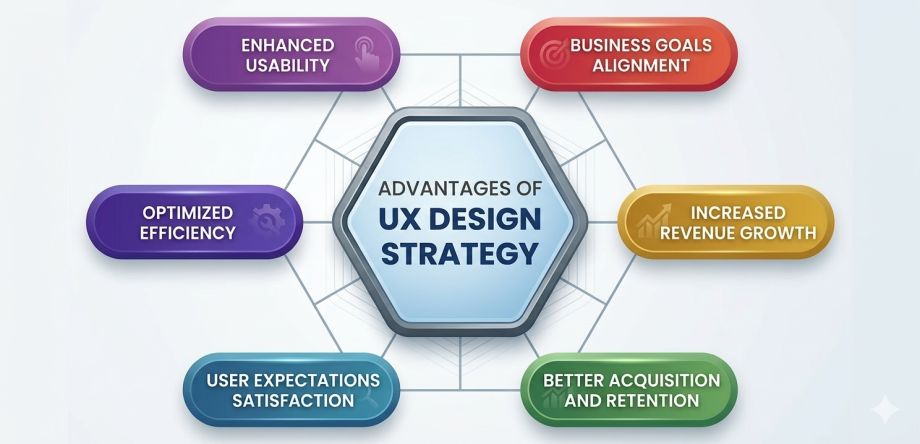

Why UX design strategy is important? A UX design strategy is important because it aligns your business goals with the actual needs of your users, ensuring that every element of your website serves a specific purpose.
While standard design focuses on how a site looks, a UX strategy focuses on how it works to drive sales, capture leads, and reduce user frustration.
In 2026, simply having a “pretty” website isn’t enough to beat the competition. You need a data-backed plan that guides visitors toward a conversion without them even realizing they are being led.
This guide explains exactly why UX design strategy is important for your brand’s growth.
What Exactly is a UX Design Strategy?
Think of your website as a house. The User Interface (UI) is the paint, the furniture, and the decorations. It’s what people see. However, the User Experience (UX) strategy is the blueprint. It determines where the doors are, how the hallways flow, and whether the kitchen is easy to use.
A strategy is the “plan of attack” that happens before a single pixel is drawn. It involves:
- User Research: Finding out who your customers are and what they want.
- Competitor Analysis: Seeing what others in your niche are doing wrong so you can do it better.
- Wireframing: Mapping out the skeleton of the site to ensure the logic makes sense.
- Testing: Using real data to see where people get stuck and fixing it.
Without this plan, you are just guessing. That is the primary reason why UX design strategy is important, it replaces guesswork with data.
The Psychology of the “Invisible” Sale
When a website is designed well, you don’t notice the design at all. Everything just feels “right.” This is because a strategic design removes friction. Friction is anything that makes a user stop and think, “Wait, how do I do this?”
If a user has to think too hard, they leave. To keep them on the page, we use a concept called Hick’s Law, which states that the more choices you give someone, the longer it takes them to make a decision.
A good UX strategy limits the noise and points the user toward one clear action. This is a core part of professional Conversion Rate Optimization (CRO). We simplify the journey so that buying from you feels like the easiest thing in the world.
Why UX Design Strategy is Important for SEO
You might think that design and SEO are two different worlds, but Google disagrees. In recent years, Google has made “User Experience” a major ranking factor through a system called Core Web Vitals.
Google tracks how users behave on your site. If people land on your page and immediately leave because it’s confusing or slow, Google will drop your rankings. However, if your UX strategy keeps people clicking and reading, Google sees your site as a high-quality resource.
This is why UX design strategy is important for your search visibility; you can’t rank well if your users are unhappy. According to research by the Nielsen Norman Group, sites with a clear strategy see much higher engagement levels, which directly feeds into better SEO performance.
4 Ways a UX Strategy Multiplies Your Conversions
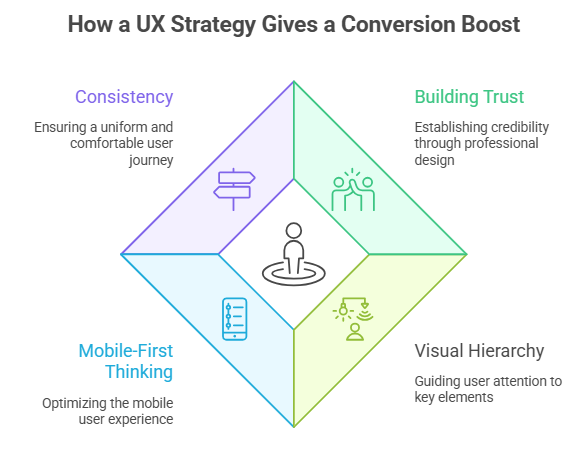
A strategic approach doesn’t just make the site look better. It makes it a better salesperson. Here are four ways it boosts your bottom line:
- Building Instant Trust: Modern users are skeptical. If a site looks outdated or “broken,” they won’t give you their credit card info. A clean, professional strategy signals that you are a legitimate, high-quality business.
- Visual Hierarchy: This is the art of telling the user what is most important. Through size, color, and placement, a strategy ensures that your “Contact Us” or “Add to Cart” button is the most obvious thing on the screen.
- Mobile-First Thinking: Most of your customers are on their phones. A UX strategy ensures that the mobile experience is just as powerful as the desktop one, preventing “fat-finger” errors and slow loading times.
- Consistency: When your site functions the same way on every page, users feel in control. This comfort is why UX design strategy is important comfort leads to confidence, and confidence leads to sales.
Reducing “Technical Debt” and Development Costs
One of the biggest mistakes business owners make is jumping straight into coding. If you build a website without a UX strategy, you will inevitably find problems later. Fixing a navigation menu or a checkout flow after it has already been coded is expensive and time-consuming.
By spending time on the strategy phase, you identify these “bottlenecks” early. It is much cheaper to move a button on a digital sketch than it is to rewrite thousands of lines of code. This efficiency is why professional Web Development always begins with a UX phase. It saves you money in the long run and ensures your site is built to scale.
Case Study
Let’s look at a non-generic example. A local service business was getting plenty of traffic but very few inquiries. They thought they needed more ads. However, our SEO Audit showed that users were getting “lost” in a mega-menu with 20 different options.
We implemented a new UX strategy that narrowed the menu down to the four most important services and added a “Quick Quote” button in the top right corner of every page.
- The Result: Without spending an extra dollar on ads, their conversion rate jumped by 35% in one month.
- The Lesson: This proves why UX design strategy is important, the traffic was already there; they just needed a better path to the finish line.
Measuring Success with the Metrics That Matter
How do you know if your UX strategy is working? You have to look at the behavior, not just the beauty. We track:
- Bounce Rate: Are people leaving immediately?
- Time on Page: Are they actually reading your content?
- Goal Completion: Are they hitting the buttons we want them to hit?
- Heatmaps: Where are they clicking, and where are they ignoring?
By constantly monitoring these numbers, we can tweak the design to keep improving your ROI. A website is never “finished”; it is an evolving tool that should get smarter over time.
Final Thoughts
Your website is often the very first interaction a customer has with your brand. If that interaction is frustrating, you’ve lost them forever. A UX design strategy is important because it respects your customer’s time.
It gives them exactly what they need, exactly when they need it, without making them work for it. In a world where your competitor is only one click away, you cannot afford to have a site that is difficult to use.
FAQs About UX Design Strategy
Does UX design strategy really impact SEO?
Yes, significantly. Google uses “user signals” like click-through rates and dwell time to determine your rankings. A site that is easy to use keeps people engaged longer, which tells Google your site is valuable and deserves a top spot.
What is the difference between UI and UX?
UI (User Interface) is the visual part, the colors, fonts, and buttons. UX (User Experience) is the internal logic, the way a user feels, and how easily they can complete a task. UI is the “look,” while UX is the “feel.”
How long does it take to see results from a UX redesign?
While a full redesign takes time to build, you can often see an improvement in metrics like “average time spent on site” and “bounce rate” within the first two weeks of launching a strategically updated page.
What is the 60/30/10 rule in UX design?
It’s a visual balance guideline: 60% dominant color (backgrounds), 30% secondary color (supporting elements), and 10% accent color (CTAs, highlights). This creates hierarchy, reduces cognitive load, and guides users toward key actions.
What are the 7 pillars of UX design?
The UX design needs to be useful, usable, findable, credible, desirable, accessible, and valuable. Together, they ensure a product meets real user needs while supporting business goals. At Ranknality, we audit every experience against these pillars to drive measurable outcomes.
What is the 80/20 rule in UX?
Also called the Pareto Principle, it suggests 80% of user value comes from 20% of features. Focus design efforts on that high-impact 20%, like core navigation or checkout flow, to maximize usability and ROI without overbuilding.
Build a Site That Converts with Ranknality
You don’t need a website that just looks nice, it needs to perform as well on the SERPs. At Ranknality, we don’t just design websites; we build high-performance sales machines. We combine deep user research with cutting-edge SEO services to make sure your brand isn’t just seen, it’s chosen.
Ready to see why UX design strategy is important for your specific business? Contact SEO Agency Ranknality today for a free UX audit, and let’s start turning your visitors into loyal customers.


 1800 W Hawthorne Ln STE Q1, West Chicago, IL 60185