
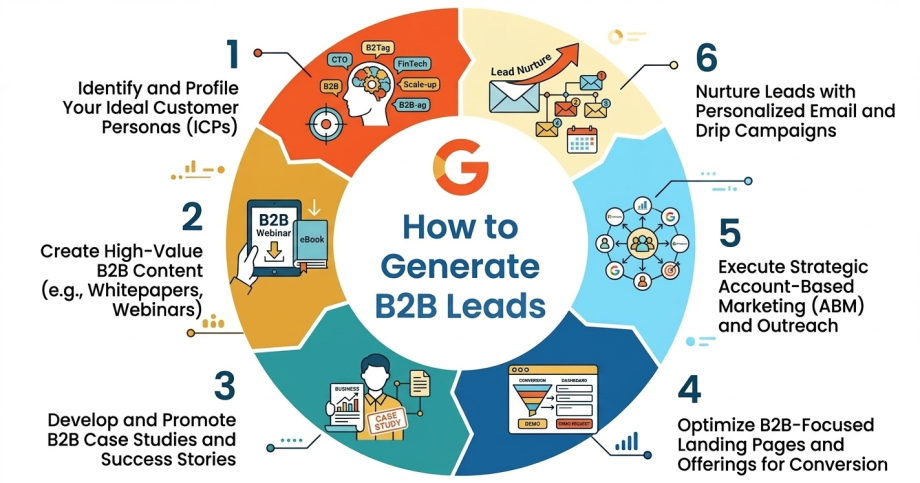
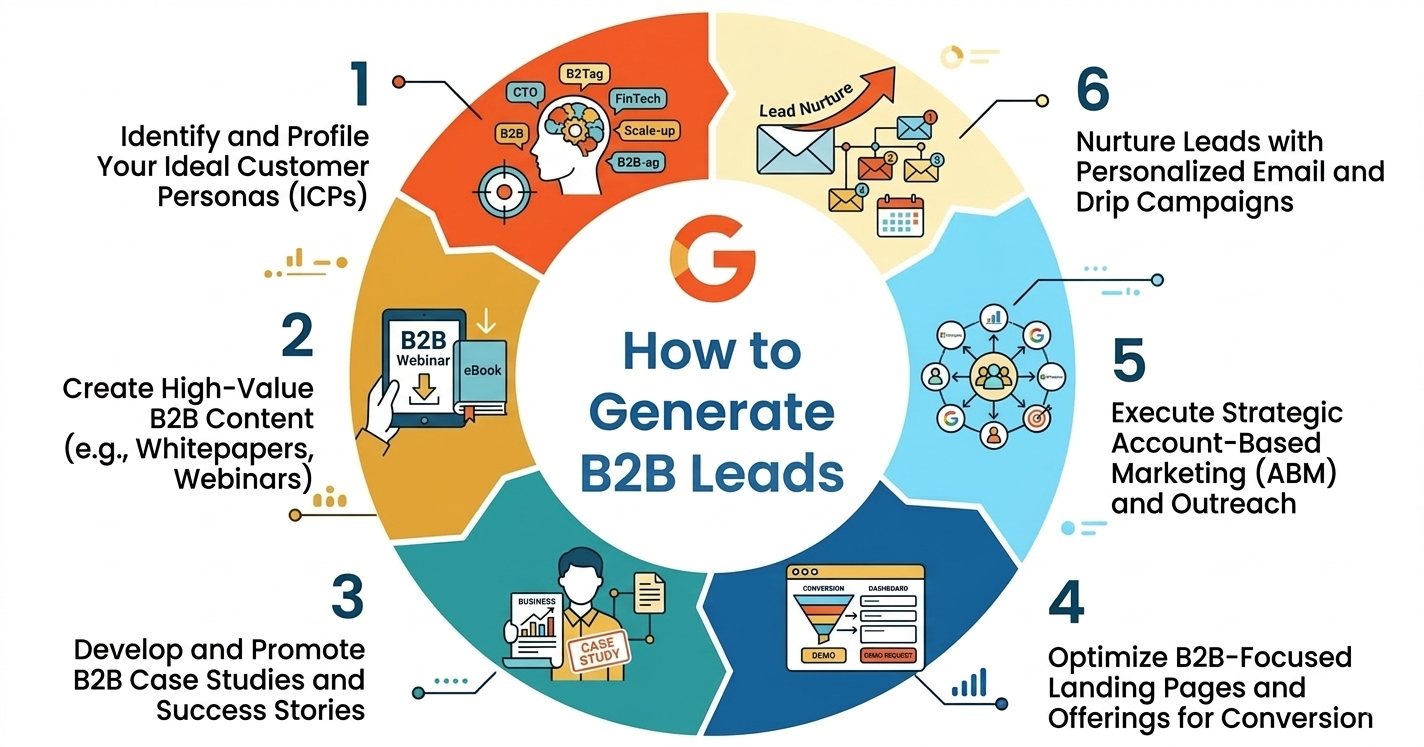

In B2B, your goal isn’t just to sell a product. You actually have to solve a real business problem. Unlike a quick retail purchase, B2B sales involve high stakes, multiple decision-makers, and long research phases. To succeed, your brand must appear as the obvious authority when an executive starts their search.
Learning how to generate B2B leads in 2026 requires moving past generic “top of funnel” traffic. You need a strategy that targets high-intent queries and builds deep trust. At Ranknality, we help you bridge the gap between appearing in search results and landing a spot in the boardroom.
What Does It Mean to Generate B2B Leads?
Generating B2B leads involves attracting and converting business decision-makers via organic search, content, and targeted outreach. You turn them into sales-qualified opportunities.
It is not about traffic. It is about the pipeline. You need quality over quantity. Every lead should have potential. That is the B2B difference.
How to Generate B2B Leads – The 5-Step Framework
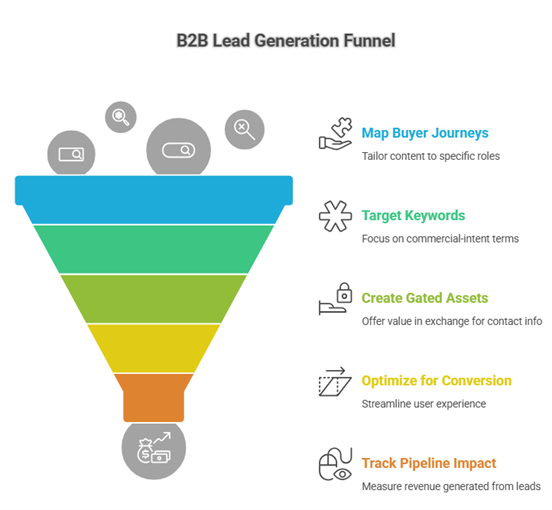
Turn searchers into opportunities with this repeatable process. You do not need to overcomplicate it. Focus on these five steps.
- Step 1: Map buyer journeys by role: CTOs care about integration. CFOs care about ROI. Tailor content accordingly. One size does not fit all.
- Step 2: Target commercial-intent keywords: Prioritize “vs,” “pricing,” “enterprise,” and “implementation” terms. These signals readiness to buy.
- Step 3: Create gated authority assets: Offer ROI calculators, benchmark reports, or demo access behind forms. Give value to get contact info.
- Step 4: Optimize for conversion, not just clicks: Use clear headlines, benefit-driven copy, and streamlined forms. Reduce friction at every step.
- Step 5: Track pipeline impact: Use CRM integration to attribute leads to keywords. Not just form fills. Measure revenue, not just traffic.
The B2B Search Shift from Intent to Volume
Many agencies focus on getting the most traffic possible. In B2B, this is a mistake. You don’t need a million visitors, you need the right fifty. Mastering how to generate B2B leads starts with identifying keywords that indicate a “commercial intent.”
For example, a generic keyword like “marketing” is too broad. However, a term like “enterprise CRM for manufacturing” is a goldmine. This person has a specific problem, a specific industry, and likely a specific budget.
By focusing on these long-tail, high-intent terms, you attract users who are already halfway through the buyer’s journey. According to Gartner, B2B buyers spend 27% of their time researching online before ever talking to a salesperson. You must be the resource they find during that time.
Build Authority with Thought Leadership
Corporate clients don’t buy from strangers; they buy from experts. This is why content is the backbone of any B2B lead generation strategy. You need to produce material that proves you understand the industry’s pain points. Whitepapers, case studies, and deep-dive blog posts are essential.
When you consistently provide the best answers to industry questions, Google rewards you with higher rankings. This is the most sustainable way to lower your cost-per-lead. If you don’t have the internal resources to produce high-level insights, our Content Writing Services can help. We create the authoritative content that decision-makers actually want to read.
Using Account-Based Marketing (ABM) and Search
A modern approach to how to generate B2B leads involves Account-Based Marketing. This is where you target specific companies rather than a broad audience. You can use SEO services to support this by creating “sales enablement” content tailored to specific niches.
Imagine you are trying to land a contract with a logistics giant. You could create a landing page or a blog post specifically about “Solving Cold Chain Challenges in 2026.” When their team searches for those solutions, your brand is the one that appears with the answer. This hyper-targeted approach ensures your SEO Management efforts are directly supporting your sales team’s goals.
What’s the “Rule of 7” in B2B?
In B2B, a lead rarely converts on the first visit. They need multiple “touches” before they trust you enough to book a demo. This is the “Rule of 7,” which suggests a prospect needs to see your core brand message at least seven times.
You can achieve this through a multi-channel approach:
- Search: They find your blog post on Google.
- Retargeting: They see an ad on LinkedIn.
- Email: They download a guide and join your newsletter.
- Direct: They type your URL into their browser to show a colleague.
When you understand how to generate B2B leads as a long-term relationship, you stop pushing for the “quick win” and start building a high-value pipeline.
How We Helped Scale a SaaS Business Pipeline
Ranknality recently worked with a B2B SaaS company that was struggling to reach enterprise-level clients. They were getting plenty of “freemium” sign-ups but no corporate contracts.
We shifted their focus from generic keywords to “Enterprise + [Service]” keywords. We also helped them develop a series of “Comparison Guides” (e.g., Our Software vs. The Competitor).
- The Result: Within six months, their organic lead volume from Fortune 500 companies grew by 85%.
- The Key: We stopped chasing traffic and started chasing the right intent.
Finalizing Your Lead Capture
Ranking is useless if your website is a maze. B2B websites need to be fast, professional, and easy to navigate. Every page should have a clear “next step.” Whether it’s “Download the Full Report” or “Schedule a Discovery Call,” make it easy for a busy executive to take action.
If your site is underperforming, an SEO Audit can reveal exactly where decision-makers are dropping off. Learning how to generate B2B leads is as much about the destination as it is about the journey.
FAQs
What is the rule of 7 in B2B?
In simple terms, the rule of 7 is a marketing principle stating that a prospect needs to encounter your brand message at least seven times before they are ready to make a purchase decision. In B2B, this often involves a mix of search results, social media, and direct email communication.
What are the best free B2B lead generation tools?
The best free tools start with Google Search Console to track what your customers are searching for. LinkedIn (free version) is excellent for networking, while HubSpot offers a free CRM to track your leads and automate basic follow-ups.
Can ChatGPT do lead generation?
ChatGPT is an incredible assistant for researching buyer personas, drafting outreach emails, and brainstorming high-intent keywords. However, it cannot replace a strategic SEO plan or the human trust-building required to close a high-ticket B2B deal.
What is the 5-minute rule for leads?
This rule suggests that your chances of qualifying a lead drop significantly if you don’t respond within five minutes of their inquiry. In B2B, being the first to respond to a “Request for Quote” often gives you a massive competitive advantage.
What is the average cost per lead for B2B?
The average cost per lead (CPL) varies by industry but typically ranges from $150 to $300. By investing in organic SEO, you can significantly lower this CPL over time as your content begins to generate “free” leads around the clock.
Scale Your Corporate Growth with Ranknality
B2B success isn’t about luck; it’s about being the most visible and trusted authority in your niche. At Ranknality, we specialize in the technical and strategic SEO that gets you in front of decision-makers when it matters most.
Ready to fill your pipeline with high-value leads? Contact SEO Agency Ranknality today for a custom B2B growth audit, and let’s start scaling your revenue together.



 1800 W Hawthorne Ln STE Q1, West Chicago, IL 60185