
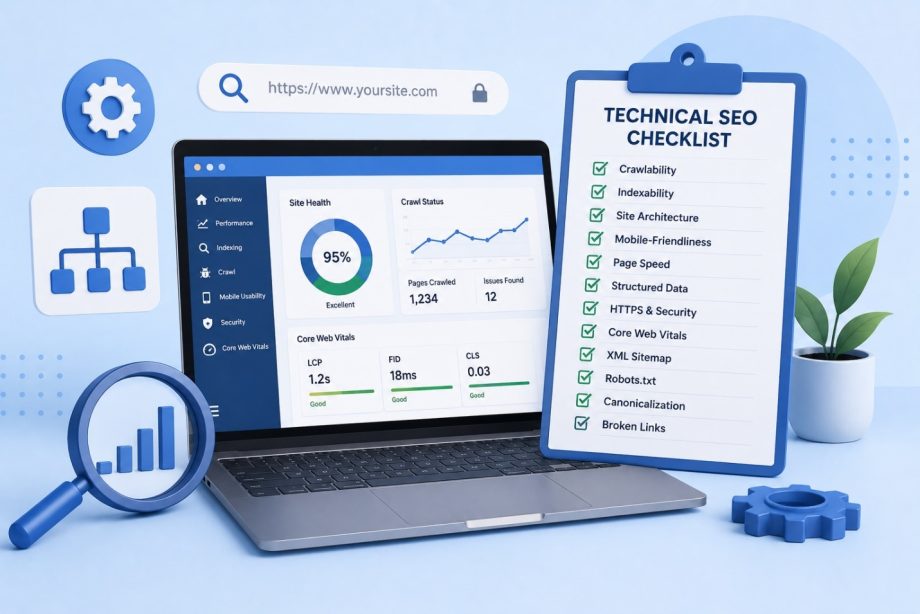
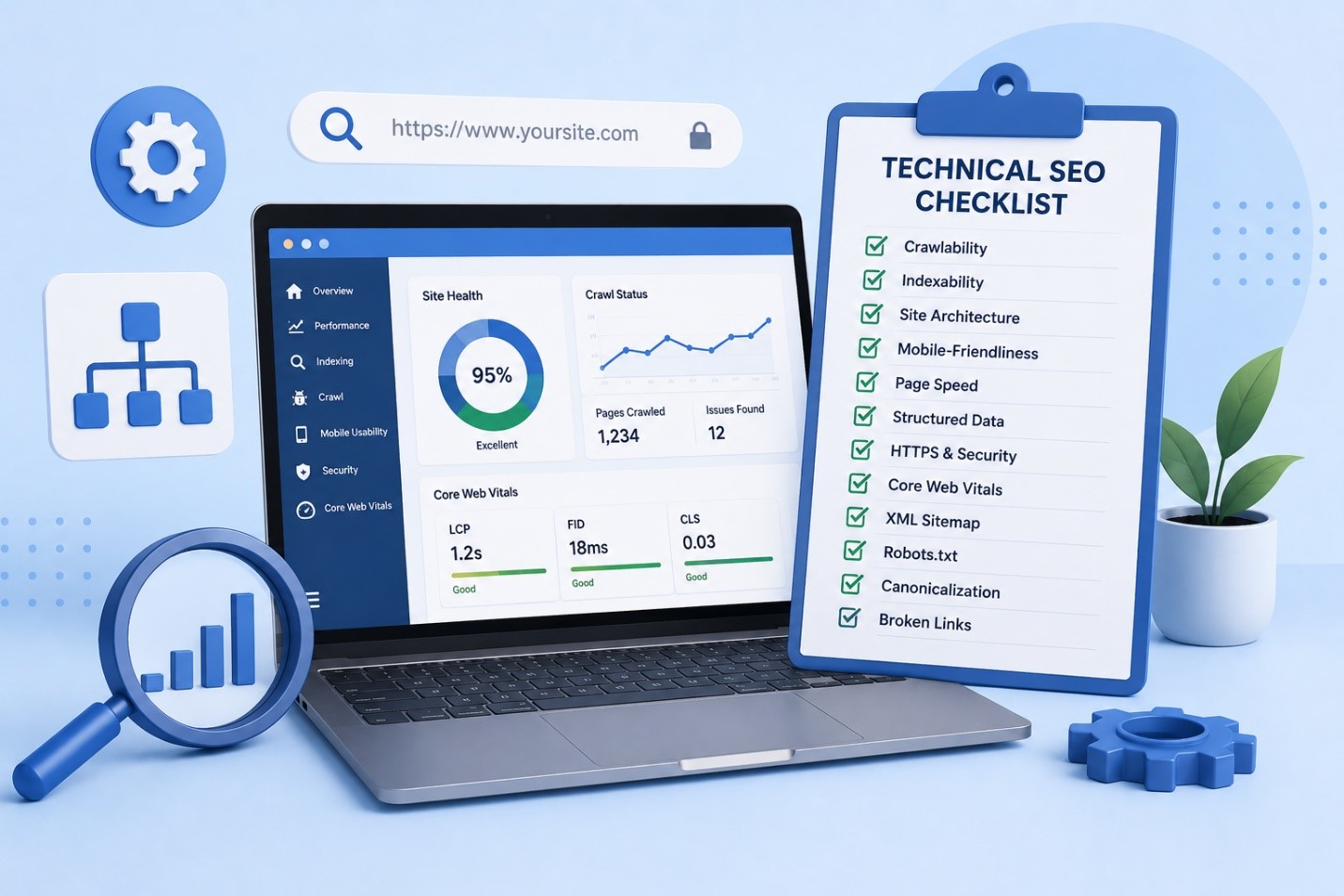

What is the first step to ranking on page one? It is fixing the technical things under the hood.
A technical SEO checklist is a comprehensive series of tasks used to ensure search engines can crawl, index, and examine your website without any friction.
In 2026, technical health is no longer just about clean code. Instead, now you have to improve the “page experience” signals that Google uses to judge your brand’s quality. If your site is slow, complicated, or broken, search engines will simply ignore you.
What Is the Technical SEO Checklist for 2026?
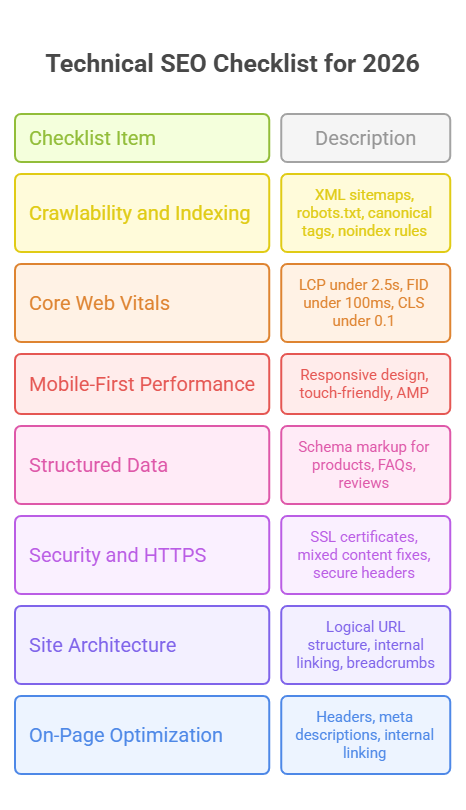
With the way the search engines have evolved today, to dominate the rankings, you must go beyond simple fixes and address the entire digital ecosystem of your site. If you aren’t auditing these seven pillars regularly, you are leaving money on the table.
So, what do you make your site fully optimized?
Well, here’s Ranknality’s complete technical SEO checklist that will help you look for the digital handbrakes holding back your organic growth.
- Crawlability and Indexing
- Site Architecture
- Page Speed and Core Web Vitals
- Mobile-First Performance
- Structured Data (Schema)
- Security and HTTPS
- On-Page Optimization
1. Crawlability and Indexing
If Googlebot can’t crawl your site, you don’t exist. It’s that simple. We start every technical SEO audit by looking at your “Crawl Budget.” If your site has thousands of low-value, duplicate pages, Google wastes its time on junk instead of your high-converting assets.
Key actions:
- XML Sitemaps: Ensure your sitemap is dynamic and only includes “200 OK” pages.
- Robots.txt: Clean up this file to ensure you aren’t accidentally blocking your most important service pages.
- Canonicalization: Use canonical tags to tell Google which version of a page is the original copy, preventing duplicate content penalties.
2. Site Architecture
Your site structure should be intuitive, not a labyrinth. A “flat” architecture, where any page is accessible within three clicks of the homepage, is the gold standard.
Here are some best practices you may follow for URL optimization:
- Use descriptive keywords in URLs
- Keep URLs short and readable
- Avoid unnecessary parameters
- Maintain consistent naming conventions
When we worked with a growing SaaS client last year, their organic traffic had plateaued despite publishing great content. A deep technical SEO audit revealed that their most important tools were buried deep in sub-directories that search engines rarely visited.
By restructuring their navigation and creating a logical “Silo” effect, we saw their indexed pages jump by 40% in just six weeks. This proved that how you organize information is just as important as the information itself.
3. Page Speed and Core Web Vitals
In 2026, “fast” isn’t a vanity metric. It’s a ranking factor. Google uses Core Web Vitals to measure the actual experience of a user. If your site “jumps” as it loads (Cumulative Layout Shift) or takes too long to respond to a click (Interaction to Next Paint), your rankings will suffer.
Effective site speed optimization involves more than just shrinking images. You need to address:
- Server Response Times: High-quality hosting is the first step to a fast site.
- Code Minification: Stripping away useless characters from your CSS and JavaScript.
- Lazy Loading: Ensuring images only load as the user scrolls to them.
When you prioritize site speed optimization, you aren’t just pleasing a robot; you are reducing the friction that stops a user from becoming a lead.
4. Mobile-First Performance
Google has moved entirely to mobile-first indexing. This means the desktop version of your site is essentially a secondary thought to the algorithm. Your mobile SEO performance must be flawless. We often find that sites look great on a desktop but become unusable on a smartphone due to intrusive pop-ups or buttons that are too close together.
That’s why you need to perform the following mobile optimization checks:
- Ensure text is readable without zooming
- Confirm buttons and links are easy to tap
- Test page loading speed on mobile devices
- Avoid intrusive pop-ups that block content
A high-performing mobile SEO performance strategy ensures that your site is lightweight and responsive. If a user on a shaky 5G connection can’t load your site in three seconds, they are gone. This technical soundness is what our SEO Services focus on, making sure your site works everywhere, for everyone.
5. Structured Data
Schema markup is the “translator” between your human-readable content and the machine-learning models of search engines. By using JSON-LD, you tell Google exactly what your page is about. Is it a product? An event? A medical practice?
In the era of AI Overviews, structured data is your ticket to being cited as a source. It allows you to earn “Rich Snippets,” those gold stars and price points that make your listing stand out in a sea of text. This technical layer is a mandatory part of any modern technical SEO checklist.
6. Security and HTTPS
Security is a “table stake” in 2026. If your site doesn’t have a valid SSL certificate (HTTPS), Google will flag it as “Not Secure” to users. This kills your bounce rate and your trust.
Beyond the SSL, you should also monitor for malware and ensure your CMS is always updated. Trust is the hardest thing to earn, and you may lose it with these technical issues.
Here are quick security-related tasks that you must do for technical SEO:
- Install an SSL certificate
- Redirect HTTP pages to HTTPS
- Monitor security vulnerabilities
- Update software and plugins regularly
7. On-Page Optimization
Technical SEO provides the foundation, but on-page SEO optimization brings it to life. This is where your headers (H1-H4), meta descriptions, and internal linking come into play. Your internal links should act as “roads” that guide Google to your most important pillar pages.
When you combine a strong technical backend with expert on-page SEO optimization, your SEO Content Writing Services become significantly more effective. You aren’t just shouting into a void; you are speaking through a megaphone. Every piece of content should be supported by a site that is technically ready to handle the traffic.
FAQs
What does technical SEO include?
Technical SEO includes all the “behind-the-scenes” elements of your website. This covers crawlability, indexation, site architecture, page speed, mobile responsiveness, SSL security, and structured data markup. Its goal is to make it as easy as possible for search engines to access and understand your content.
Can ChatGPT do an SEO audit?
ChatGPT can provide a general technical SEO checklist and analyze small snippets of code, but it cannot crawl your entire live site. It cannot see how your server behaves or how different plugins conflict with each other. A professional audit requires specialized crawlers and human expertise to solve deep-rooted issues.
How often should I run a technical audit?
For most businesses, we recommend a deep audit every six months. However, if you are an e-commerce brand or frequently update your site, a quarterly check is necessary to catch “broken” links or indexing errors before they impact your revenue.
Why is my site speed slowing down?
Site speed often slows down due to “plugin bloat,” unoptimized images, or poor server performance. Regular maintenance is required to keep your code clean and your load times fast.
What is the most important part of the technical SEO checklist?
Indexation. If search engines can’t index your pages, none of your other efforts, from content to backlinks, will matter. You must ensure that your most valuable pages are being seen by Google.
Fix Your Site’s Technical SEO with Ranknality
A structured technical SEO checklist is one of the most valuable tools for maintaining search visibility in 2026. It ensures your website remains fast, secure, and accessible to both users and search engines.
Technical optimization may not always be visible to visitors, but it’s important for rankings, engagement, and conversions. Businesses that prioritize technical SEO build stronger foundations for long-term growth.
By following the best practices we outlined here and conducting regular audits, you can identify issues early, improve performance, and stay ahead of competitors in this increasingly smart search environment.
Not sure how to fix your site’s technical SEO? Book your consultation today, and let Ranknality build a custom audit that answers your technical SEO checklist with action.





 1800 W Hawthorne Ln STE Q1, West Chicago, IL 60185