

Choosing the wrong foundation for your online store is a silent killer for your growth.
You can have the best products in the world, but if your website is built on a platform that “hides” you from Google, you are essentially invisible.
What we’ve seen in 2026 so far is that search engines are more demanding than ever. They want speed, security, and perfectly structured data.
This brings us to a critical question for every entrepreneur: which ecommerce platform is best for SEO?
Well, AI-powered search results and stricter performance standards mean you need a platform that supports modern SEO from day one.
Table of Contents
Which Ecommerce Platform is Best for SEO? A 2026 Comparison
SEO Factors That Actually Matter in 2026
Which Ecommerce Platform is Best for SEO in 2026? Top Platforms Compared
Platform-by-Platform SEO Breakdown
Is Shopify or WooCommerce better for SEO?
Shopify
WooCommerce
What Recent AI Developments in Search Mean for Ecommerce SEO
Technical SEO Considerations for Ecommerce Sites in 2026
How a DTC Brand 3x’d Organic Revenue After Platform Migration
Our Strategy
Results at Month 5
Why Your Platform is Only the Beginning5
The Bottom Line
Frequently Asked Questions
Which ecommerce platform is best for SEO for beginners?
Does site speed really affect ecommerce rankings?
Can I change my platform without losing my SEO?
What are the most important ecommerce SEO features to look for?
Is Wix or Squarespace good for ecommerce SEO?
SEO Factors That Actually Matter in 2026
Google’s 2026 algorithm prioritizes user experience and technical precision. Here is what to evaluate when you compare platforms.
- Core Web Vitals: LCP, FID, CLS. Platforms must deliver fast, stable, responsive pages. Speed is a ranking factor.
- URL and Site Structure: Clean, logical URLs help Google crawl and index efficiently. Avoid messy parameters.
- Schema Markup: Product, review, and breadcrumb schema boost rich snippet visibility. You stand out in results.
- Mobile-First Performance: Over 70 percent of ecommerce traffic is mobile. If it lags, you lose sales.
- App or Plugin Ecosystem: Can you add SEO tools without breaking your site? Flexibility matters.
This ecommerce SEO comparison is not about feature lists. It is about real-world performance. And why strong ecommerce platform SEO features separate winners from also-rans. You need a platform that works for your audience.
Need help auditing your current store? Our Ecommerce SEO services identify technical gaps holding you back.
Which Ecommerce Platform is Best for SEO in 2026? Top Platforms Compared
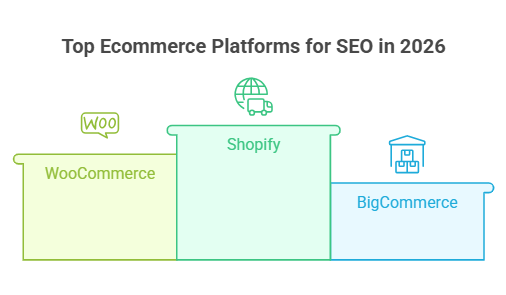
There isn’t a single winner for every business. The right ecommerce platform depends on your goals, budget, and technical resources.
Still, some platforms consistently perform better for search visibility.
When evaluating which ecommerce platform is best for SEO, these are the platforms most businesses consider:
- Shopify
- WooCommerce
- BigCommerce
- Magento (Adobe Commerce)
- Wix Ecommerce
Each platform offers strengths. Each also has trade-offs.
Platform-by-Platform SEO Breakdown
The best ecommerce platform for SEO is the one that supports your long-term growth, not just your launch. Here is how the top contenders stack up in the 2026 search engines:
- Shopify: The gold standard for speed and reliability. Its global CDN ensures your store loads fast everywhere, though its rigid URL structure can be a minor hurdle for advanced users.
- WooCommerce: Offers total creative freedom. Since it sits on WordPress, you have access to the best SEO plugins in the world, provided you have a fast host.
- BigCommerce: Best for large catalogs. It includes more “out-of-the-box” ecommerce SEO features than almost any other platform, making it a favorite for mid-market brands.
- Magento (Adobe Commerce): The enterprise choice. It is infinitely customizable but requires a dedicated technical team to manage its complexity.
- Wix Ecommerce: The most improved player. While it was once avoided by SEOs, Wix now offers robust tools and fast speeds for small-to-medium boutiques.
| Platform | SEO Strength | Best For | Technical Control |
| Shopify | High (Speed) | General Retail | Medium |
| WooCommerce | High (Customization) | Content-Heavy Brands | High |
| BigCommerce | High (Built-in Tools) | High-Volume Stores | Medium |
| Magento | Maximum (Scalability) | Enterprise | Absolute |
| Wix | Medium/High (Simplicity) | Small Boutiques | Medium |
Is Shopify or WooCommerce better for SEO?
This is the ultimate debate in the industry. Both are powerhouses, but they cater to very different types of business owners.
Shopify
Shopify is the “Apple” of ecommerce. It is fast, secure, and incredibly reliable. For most stores, Shopify provides about 90% of what you need right out of the box. Google loves its fast global CDN (Content Delivery Network).
However, Shopify does have some rigid structures, like forced URL paths (e.g., /products/ and /collections/), which can be slightly frustrating for SEO purists.
Choose Shopify if:
- You want fast setup with minimal technical overhead
- You prioritize uptime, security, and integrated hosting
- You are okay with some SEO limitations in exchange for simplicity
WooCommerce
WooCommerce is the “Android” of the group. Since it runs on WordPress, you have 100% control over every single line of code. You can customize your meta tags, redirects, and schema exactly how you want.
The downside? You are responsible for your own hosting and security. If you don’t keep your site optimized, it can become slow and bloated.
Choose WooCommerce if:
- You need full control over URLs, schema, and site architecture
- You have developer support or in-house SEO expertise
- You want to scale customization without platform constraints
So, which ecommerce platform is best for SEO? If you want a “set it and forget it” high-performance site, Shopify wins. If you want total technical freedom and have the resources to manage it, WooCommerce is the superior choice for a long-term ecommerce SEO strategy.
What Recent AI Developments in Search Mean for Ecommerce SEO
In 2026, we are no longer optimizing only for blue links like we used to. We are optimizing for AI Overviews (SGE). Search engines are now pulling data directly from your product pages to answer user questions.
To win in this environment, your platform must support “Entity-Based SEO.” This means your “Product Schema” needs to be more detailed than ever, including information on availability, materials, and shipping times.
Both Shopify and WooCommerce have released updates to help with this, but Shopify’s built-in AI tools currently have a slight edge in generating search-compliant descriptions at scale.
Want faster load times? Our Technical SEO Services optimize Core Web Vitals for conversions.
Technical SEO Considerations for Ecommerce Sites in 2026
Recent developments change the game. Here is what to watch when evaluating platforms.
- AI Overviews and SGE: Platforms must serve clear, structured content to appear in generative results. Vague content gets ignored.
- Page Experience Signals: Mobile usability, safe browsing, and HTTPS are non-negotiable. Google penalizes poor UX.
- Canonical Tags: Does the platform allow for easy Canonical Tags? This prevents Google from getting confused when you have the same product in different colors or sizes.
- JavaScript Rendering: Googlebot renders JS, but heavy frameworks can delay indexing. Keep it lean.
- International SEO: Multi-currency, hreflang, and geo-targeting support matter for global stores.
- Custom Sitemap: Does it allow for a Custom Sitemap? Search engines use these to find your new products. Some platforms often auto-generate a messy sitemap that Google refuses to crawl.
This is why ecommerce platform SEO features must evolve with search. And why a thorough ecommerce SEO comparison includes future-proofing. You need to have a platform that adapts as Google does.
How a DTC Brand 3x’d Organic Revenue After Platform Migration
Client: Premium skincare DTC brand with 2 million dollars in annual revenue.
Challenge: Stuck on a legacy platform with slow load times, poor mobile UX, and limited SEO control.
Our Strategy
- Migrated to Shopify Plus with a custom theme optimized for Core Web Vitals.
- Implemented product schema, collection page optimization, and blog content strategy.
- Fixed crawl errors, redirected legacy URLs, and streamlined navigation.
Results at Month 4
- 3.1x increase in organic revenue.
- 68 percent improvement in LCP (Largest Contentful Paint).
- 42 percent higher conversion rate from organic traffic.
- Top 3 rankings for 15+ commercial-intent keywords.
This was the result of our intentional platform selection plus expert execution. And proof that which ecommerce platform is best for SEO depends on how well you implement it. The right choice plus the right strategy equals growth.
Why Your Platform is Only the Beginning
Picking the platform is like buying a car. It gives you the potential to go fast, but you still need a driver. Even the best platform requires a content strategy, backlink building, and regular audits.
We recommend pairing your choice with professional SEO Content Writing Services to ensure your product descriptions aren’t just informative, but are designed to rank.
The Bottom Line
Comparing which ecommerce platform is best for SEO is not about picking the most powerful tool. It is about matching platform strengths to your team’s skills, your growth stage, and your technical capacity. In 2026, speed, structure, and adaptability win.
Ready to build a store that ranks?
Let Ranknality help you choose and optimize the ecommerce platform that is best for SEO. We build a strategy for your audience, your goals, and your bottom line.
Make the decision that serves your future. Book Your Free Ecommerce SEO Consultation.
Frequently Asked Questions
Which ecommerce platform is best for SEO for beginners?
Shopify is widely considered the best for beginners. It handles technical essentials like SSL certificates, sitemaps, and mobile optimization automatically, allowing you to focus on selling.
Does site speed really affect ecommerce rankings?
Yes, it is one of the most critical factors. In 2026, Google uses “Core Web Vitals” to measure user experience. If your platform is slow to load or “shifts” content as it loads, your rankings will drop regardless of how good your keywords are.
Can I change my platform without losing my SEO?
Yes, but it requires a very careful “Migration Plan.” You must use 301 redirects to tell Google where your old pages have moved. If you skip this migration step, you will lose all the authority you have built over the years.
What are the most important ecommerce SEO features to look for?
The “must-haves” include custom meta titles/descriptions, automatic 301 redirects, schema markup support, fast loading speeds, and a mobile-responsive checkout. Without these, you will struggle to compete in high-volume niches.
Is Wix or Squarespace good for ecommerce SEO?
Both have improved significantly, but they still lack the advanced technical SEO for ecommerce control found in Shopify or WooCommerce. They are fine for very small hobby stores, but serious brands usually outgrow them quickly.

 1800 W Hawthorne Ln STE Q1, West Chicago, IL 60185