

Most people think marketing is just about making “pretty ads” or posting on Instagram. In reality, marketing is the entire nervous system of your business. It is the process that keeps your brand alive, healthy, and growing. If you only focus on promotion but ignore your data or your pricing, your growth will eventually stall.
To build a brand that lasts, you must understand the 7 functions of marketing. These functions act as a roadmap, connecting your product to your customer in a way that generates consistent revenue and long-term loyalty.
What Exactly are the Marketing Core Functions?
Marketing is not a single department. It is a series of steps that takes an idea from a brainstorm and puts it into a customer’s hands. These are often called marketing core functions because they represent the essential pillars of any business.
Whether you are a solo founder or a growing team, the 7 functions of marketing help you see the “big picture.” They ensure that you aren’t just busy, but that you are actually being effective.
What are the 7 Functions of Marketing?
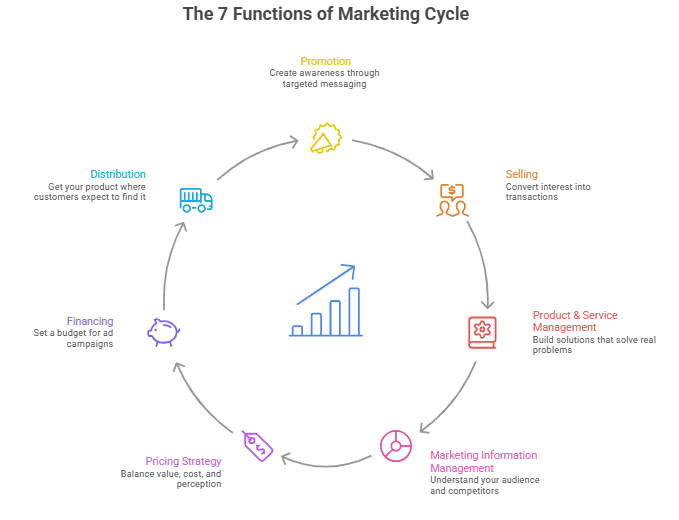
They are the core activities that move a product from idea to loyal customer. You cannot skip steps. Each function supports the next. Here is the breakdown:
- Promotion: Create awareness through targeted messaging across channels.
- Selling: Convert interest into transactions through effective sales processes.
- Product & Service Management: Build solutions that solve real problems, not just imagined ones.
- Market Research: Understand your audience and competitors before spending money.
- Pricing Strategy: Balance value, cost, and perception to ensure profitability.
- Financing: Set a budget for your ad campaigns to help new buyers find you.
- Distribution: Get your product where customers expect to find it.
1. Promotion to Create the Buzz
Promotion is usually what people think of first. It is how you tell the world you exist. In 2026, this goes far beyond just TV ads or billboards. It involves:
- Digital storytelling through social media.
- Email campaigns that nurture leads.
- Search engine visibility.
- Influencer partnerships.
If you want to reach more people where they actually spend their time, our Social Media Marketing Services can help you craft a voice that stands out.
2. Selling for Closing the Loop
The goal of all your marketing is to make the sales process easier. Selling is the direct communication with customers to handle their needs and close the deal. In the digital world, this often happens through automated funnels or high-converting landing pages.
Marketing “warms up” the lead so that when it’s time to buy the product, the customer feels confident in their choice.
3. Product and Service Management
This function is all about the “what.” It involves designing, developing, and improving your offerings based on what the market wants. Effective product and service management means you are constantly listening to feedback and making your product better. If your product doesn’t solve a real problem, no amount of advertising will save it.
4. Marketing Information Management
How do you know if your strategy is working? You look at the data. This involves gathering and analyzing information about your customers, competitors, and trends. In the digital age, marketing information management is your most valuable asset.
It helps you understand the dynamics without guesswork. You cannot master the 7 functions of marketing without using tools like Google Analytics to see exactly how people interact with your brand.
5. Pricing for the Value Balance
Pricing is a psychological game. If your price is too low, people might think your quality is poor. If it’s too high without enough value, they will go to a competitor. Strategic distribution and pricing strategies help you find the sweet spot where you have the opportunity to maximize profit while remaining attractive to your target audience. Your price tells a story about your brand, make sure it’s the right one.
6. Financing to Fuel the Growth
Marketing costs money. Financing as a marketing function involves setting a budget for your campaigns and finding ways to help your customers pay. This could mean offering “Buy Now, Pay Later” options or securing a line of credit to scale your ads. If you can’t afford to reach new people, your business cannot grow.
7. Distribution to Get it to the User
Distribution is how your product gets to the customer. For a bakery, it’s a physical storefront. For a software company, it’s a digital download. Today, modern distribution and pricing strategies often focus on being “easy to find” online.
This is where our Local SEO Services come in. We make sure that your “digital distribution” is seamless so that customers can find and buy from you in seconds. This final piece of the 7 functions of marketing ensures that all your hard work actually reaches the end-user.
Why All Marketing Core Functions Matter Together
Think of these functions like the wheels on a car. If one is flat, the car might move, but it will be a bumpy ride and you won’t get very far. Successful brands treat their marketing core functions as an interconnected ecosystem. You need data to set your price, a great product to sell, and promotion to let people know it exists.
When you align these areas, you create a “flywheel” effect where each function helps the others work better. If you need help seeing how your digital presence fits into this puzzle, our SEO Management Services provide the technical foundation to support your entire strategy.
Hurdles That May Break the 7-Function Framework
Even smart teams stumble. Avoid these pitfalls. They are common and costly.
- Siloed teams: Research does not talk to product. Promotion does not align with selling. Information gets stuck.
- Skipping research: Building based on assumptions, not data. This leads to products nobody wants.
- Over-investing in promotion: Ignoring service or pricing undermines long-term ROI. You buy traffic but lose customers.
- Static planning: Markets shift. Your functions must adapt. What worked last year might not work now.
The 7 functions of marketing only deliver results when they are connected. That is the fresh angle. It is not about doing more. It is about syncing better. Many businesses hire an agency for promotion only. Then they wonder why sales do not improve. The issue might be pricing. Or distribution. Or service. You need a holistic view.
For deeper framework context, see the American Marketing Association’s definition of marketing. For strategic integration insights, reference Harvard Business Review on marketing alignment. These resources confirm that integration drives performance. Do not let internal friction slow you down.
FAQs
What is the most important function of marketing?
There isn’t just one “best” function, but many experts point to Marketing Information Management. Without good data, you are essentially flying blind, which makes the other six functions much harder to execute correctly.
How do these functions help a small business?
For a small business, these functions provide a checklist to ensure you aren’t ignoring critical areas. It helps you move from just “selling a product” to “building a professional brand” that can compete with larger companies.
What is the difference between marketing functions and the 4 Ps?
The 4 Ps (Product, Price, Place, Promotion) are a simpler model for marketing. The 7 functions are a more detailed, business-wide view that includes things like financing and information management, which are vital for daily operations.
Can I outsource these functions?
Yes. Most businesses outsource Promotion (to agencies) or Distribution (to logistics partners). However, you should always keep a close eye on Product Management and Pricing, as these are the heart of your brand identity.
How does AI change these 7 functions?
AI is drastically speeding up Information Management by analyzing data in seconds. It is also changing Promotion by creating personalized ads and Selling through intelligent chatbots that can talk to customers 24/7.
Ready to Align Your Marketing for Real Growth?
Your business deserves a strategy that works as hard as you do. If your current efforts are not delivering leads, it is time for a change. Let Ranknality help you master the 7 functions of marketing. We build a strategy that connects research, execution, and results.
Do not let siloed efforts hold you back. Book Your Free Marketing Audit today. Let us build your growth engine together.



 1800 W Hawthorne Ln STE Q1, West Chicago, IL 60185